Ranchi: Jharkhand has taken its first coordinated step towards preventing drowning deaths by bringing government departments, technical agencies and development partners together to begin the groundwork for a State Action Plan on Drowning Prevention.
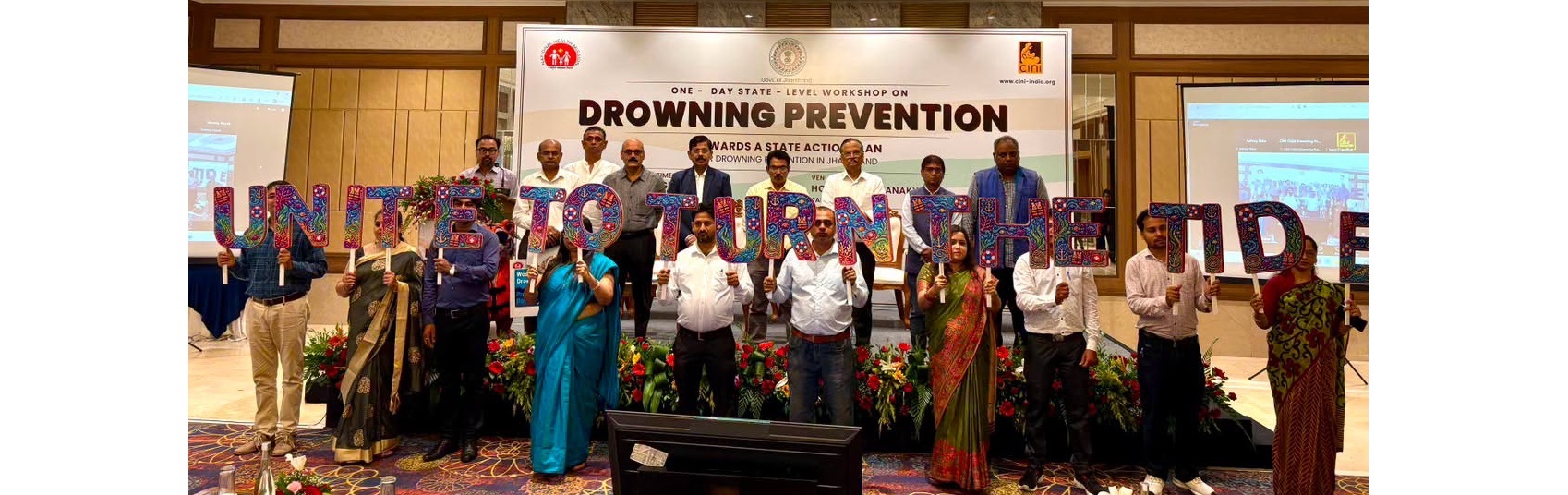
The National Health Mission, Government of Jharkhand, convened the first State Level Workshop on Drowning Prevention on Wednesday in the capital city, Ranchi. Child in Need Institute (CINI) supported the coordination of the consultation.
The initiative marks a shift from responding only after an emergency to preventing drowning through reliable data, safer environments, prepared communities and coordinated government action.
According to the Jharkhand Disaster Management Department, 431 people died in disaster related incidents between 1 May and 31 July 2025. Drowning accounted for 161 deaths, representing 37.4 per cent of all fatalities recorded during the period.
“NCRB data indicate around 675 drowning deaths in Jharkhand, nearly two lives lost every day. These figures underline the seriousness of the issue and the urgent need for coordinated prevention. This first state level workshop is an important step towards protecting lives,” said Shashi Prakash Jha, IAS, Mission Director, National Health Mission, Jharkhand.
Senior government officials attending the programme included Dr. Prabhat Kumar, Director, Health Services, Jharkhand, and State Nodal Officer for Disaster Preparedness and Response, NHM; and Rakesh Kumar, Joint Secretary, Department of Disaster Management, Government of Jharkhand. Meghendra Banerjee, Chief of Programmes, CINI, was also present and contributed to the consultation.
Officials and experts from health, disaster management, forests, water resources, mines, urban development, Panchayati Raj, academia and civil society also participated.
The programme featured virtual contributions from the World Health Organization Headquarters in Geneva, Bloomberg Philanthropies, USA, and the Royal National Lifeboat Institution, UK, bringing global perspectives to Jharkhand’s first coordinated effort to prevent drowning deaths.
The workshop was held under CINI’s month long drowning prevention initiative across eastern India, “Unite to Turn the Tide”. The campaign has connected governments, technical agencies, communities and young people across Odisha, West Bengal, Jharkhand and Assam.
For more than a decade, CINI has implemented community based approaches to drowning prevention. Its model is informed by WHO’s recommended interventions and includes supervised safe spaces for young children, barriers around hazardous water bodies, water safety and survival swimming skills, community rescue and CPR training, public awareness and convergence with government systems.
The consultation examined the Government of India’s National Strategy for Prevention of Unintentional Injuries and Drowning Prevention. Discussions focused on surveillance, district risk mapping, safety around water bodies, child supervision, community preparedness, departmental responsibilities and locally appropriate interventions.
The workshop produced an initial action framework for the next six months. Drowning hotspots across the state will be identified, and the State IEC team will support the installation of warning signage at high risk locations. A rapid survey will also be conducted in selected areas to develop a clearer understanding of the current burden and local risk patterns.
The Panchayati Raj Department will support the installation of protective barriers around priority open water bodies. The workshop also called for the immediate initiation of first responder training for frontline workers and community volunteers. These measures will generate the evidence and operational learning required to shape Jharkhand’s wider State Action Plan on Drowning Prevention.
“Drowning prevention is not a simple, single sector intervention. It requires coordinated action across sectors and communities to address the wider system around every child. We cannot prevent access to water, but we can make that access safer. Such action not only saves lives, but also strengthens child development, gender equality, economic productivity and climate resilience,” said Dr. Caroline Lukaszyk, Technical Officer, Unintentional Injury Prevention, World Health Organization Headquarters, Geneva.
“Jharkhand has brought drowning before the departments and institutions capable of preventing it. Our shared aspiration is a state where no family loses a child or an adult to a preventable drowning. This consultation provides a strong foundation for that journey,” said Sujoy Roy, Lead, Injury Prevention and National Advocacy, CINI.