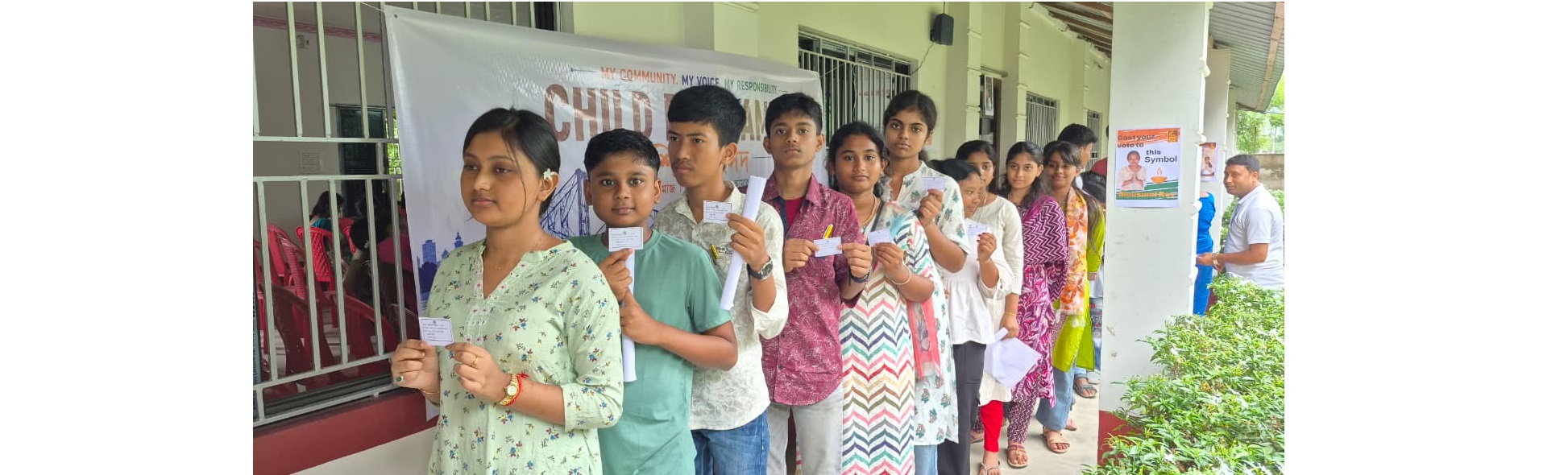
Kolkata: Democracy came alive for nearly 100 adolescents in South Dinajpur as they cast ballots, elected a Chief Minister, chose an Opposition Leader, and formed their own cabinet in the district’s first-ever educational Child Parliament election.
Organised by the Child in Need Institute (CINI), the initiative was designed to help children experience democratic processes firsthand while encouraging leadership, civic responsibility and participation in community decision-making. Officials from the Gangarampur Block Health Department, led by the Block Medical Officer of Health (BMOH), were present to observe the election process, ensuring transparency and fairness throughout the exercise.
A total of 12 candidates contested the election, with nearly 100 adolescent voters participating through a secret ballot. After polling concluded, the ballot box was opened in front of participants and votes were counted following procedures similar to those used in public elections.
The candidate securing the highest number of votes was elected Child Chief Minister, while the runner-up assumed the role of Leader of the Opposition. The newly elected Chief Minister subsequently appointed ministers for Education, Health, Information & Communication, Women and Child Welfare, and Environment & Disaster Management. The remaining candidates became members of the Child Parliament.
Unlike a mock election conducted merely as a classroom activity, the Child Parliament is intended to function as a platform where children can identify local issues, discuss solutions and engage constructively with their communities. Over the coming months, members will work across villages in Gangarampur Block to promote awareness on drowning prevention, prevention of child marriage, child rights, environmental protection and health.
Sujoy Roy, Lead – Injury Prevention & National Advocacy, CINI, said, “The Child Parliament is entirely non-political and educational in nature. It is designed to give children a meaningful voice in decision-making and to nurture leadership, responsibility and civic values from an early age. We believe children are not only the citizens of tomorrow but active stakeholders in building safer and healthier communities today.”
One of the participants described the experience as memorable. “It was my first time casting a vote. Before I become eligible to vote in a real election, this has helped me understand how democracy works,” the adolescent said.
By combining experiential learning with community action, the initiative seeks to empower children not just as beneficiaries of development programmes, but as young leaders capable of influencing positive change within their own communities.